

How do planets shape habitable environments and transform prebiotic to biotic (pb2b)?
We explore how young planets undergo PB2B transitions by assessing habitability in relation to stellar and planetary environments (IPGP) and their cosmic backgrounds (APC). Our interdisciplinary approach includes predicting and analyzing atmospheric conditions (IPGP/AIM), using observatories for direct observations, and integrating field studies, sample analysis, and laboratory experiments (IPGP). Theoretical modeling (IPGP/AIM) supports our investigations into early Earth geological conditions as a test case, examining factors such as magnetic field development, and the formation of the atmosphere, crust, and hydrosphere to determine the essential conditions for PB2B transitions and long-term habitability. This multi-messenger approach serves as a crucible for novel analysis methodologies, high-performance computing, and phenomenological and theoretical modeling, greatly benefiting from cross-fertilization between the astro- and geo-science communities. Data drives HERMES, collected from space- and ground-based observatories, terrestrial and extraterrestrial sample measurements, and simulations and models. Once analyzed, this data provides the basis for predictions, guiding future observations, experimentation, and the design of new missions.
Read more
article en anglais
Lorem ipsum dolor sit amet, consectetuer adipiscing elit, sed diam nonummy nibh euismod tincidunt ut laoreet dolore magna aliquam erat volutpat. Ut wisi enim ad minim. Lorem ipsum dolor sit amet, consectetuer adipiscing elit, sed diam nonummy nibh euismod tincidunt ut...
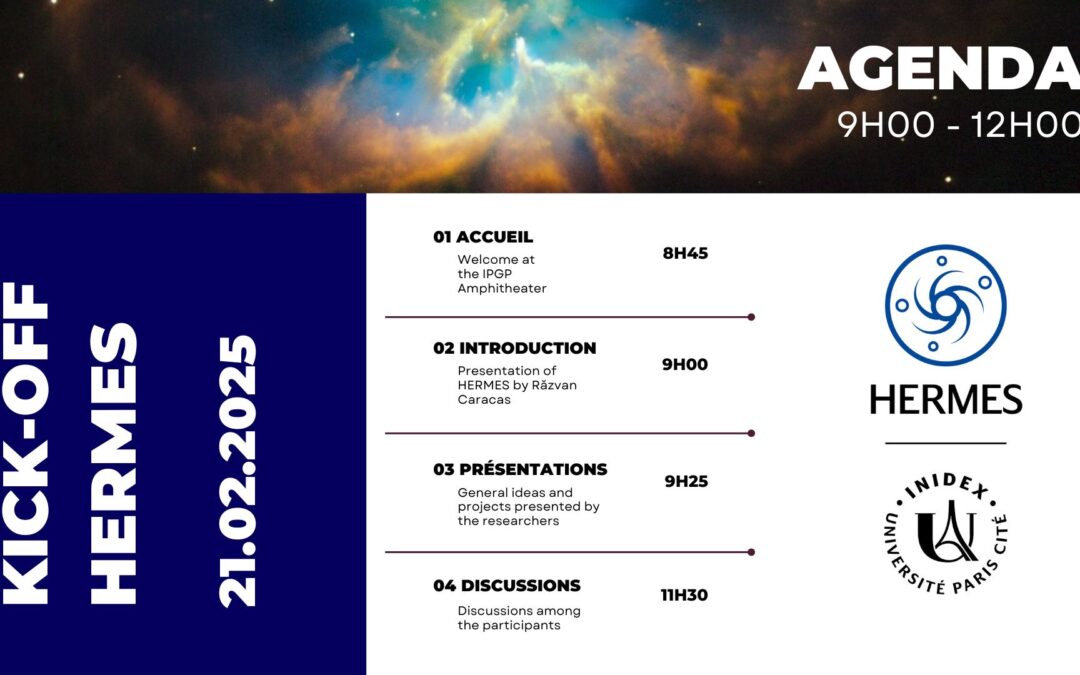
HERMES’ Kick-Off Event
On February 21, 2025, the HERMES kick-off was held in the amphitheater of the Institut de Physique du Globe de Paris. HERMES' Kick-Off at IPGP On February 21, 2025, from 9:00 AM to 12:00 PM, the official kick‑off workshop for the HERMES project was held in the...